Process design - The choreography of development

Principles and examples

Principles

Orientation

Process architectures serve as a shared model of change. They are vessels within which change can unfold and at the same time they are orientation and guardrails that provide security along a still untravelled path.

Holistic approach

Eine geeignete Gesamtarchitektur ist sowohl  Handarbeit als auch ein Griff in die kreative Kiste, um verschiedene Qualitäten miteinander zu verbinden – den analytischen Blick mit Räumen für Begegnung, die hands-on Entwicklungsarbeit mit einer transparenten Entscheidungsstruktur. Ganzheitlichkeit erfordert auch einen integrierten Blick auf Entwicklung: Strukturarbeit ohne Kulturentwicklung gerät ins Stocken; eine neue Strategie fliegt nicht ohne Strukturanpassungen; Kulturwandel braucht strukturelle Praktiken, die das „New Normal“ ins Leben bringen. Wirkungsvolle Prozessdesigns weben unterschiedliche Zugänge und Ebenen zu einem stimmigen Ganzen.

Momentum

OE-Prozesse benötigen Energie. Zuweilen sind es Einzelne oder Kleingruppen, die die entscheidenden Impulse setzen; zu anderen Zeiten braucht es die Kraft aller. Wir geben euch geeignete Formate an die Hand, um die Energie aufrechtzuerhalten und auch diejenigen kontinuierlich wieder an Bord zu holen und einzubinden, deren Fokus das Alltagsgeschäft eurer Organisation bleibt.

Ownership

Ihr wollt alle mitnehmen – ohne euch zu verzetteln? Von Befragungen über Großgruppen Workshops bis zur gemeinsamen Steuerung in Prozessgruppen gibt es eine Vielzahl bewährter Formate der Beteiligung. Wir entwickeln mit euch einen handhabbaren Prozess, in dem alle Perspektiven angemessen zum Tragen kommen und der mit euren Rahmenbedingungen in Einklang steht. Denn das Wichtigste: Aus Beteiligung entsteht Gemeinschaftssinn, Identifikation und Verantwortungsübernahme!

Example

Klassisches Prozessmodell

Jeder Prozess der Organisationsentwicklung (OE) ist ein Unikat, und dennoch fangen wir nicht immer bei Null an. Beim Design einer Prozessarchitektur passen wir erprobte Modelle und Sequenzen an eure Bedarfe und Möglichkeiten an.

  • 2-3 overall team workshops
  • Work in parallel development teams
  • Coordination via process group
  • Duration: 7-9 months Survey and
    Development, 4-6 months accompanied
    Realisation.
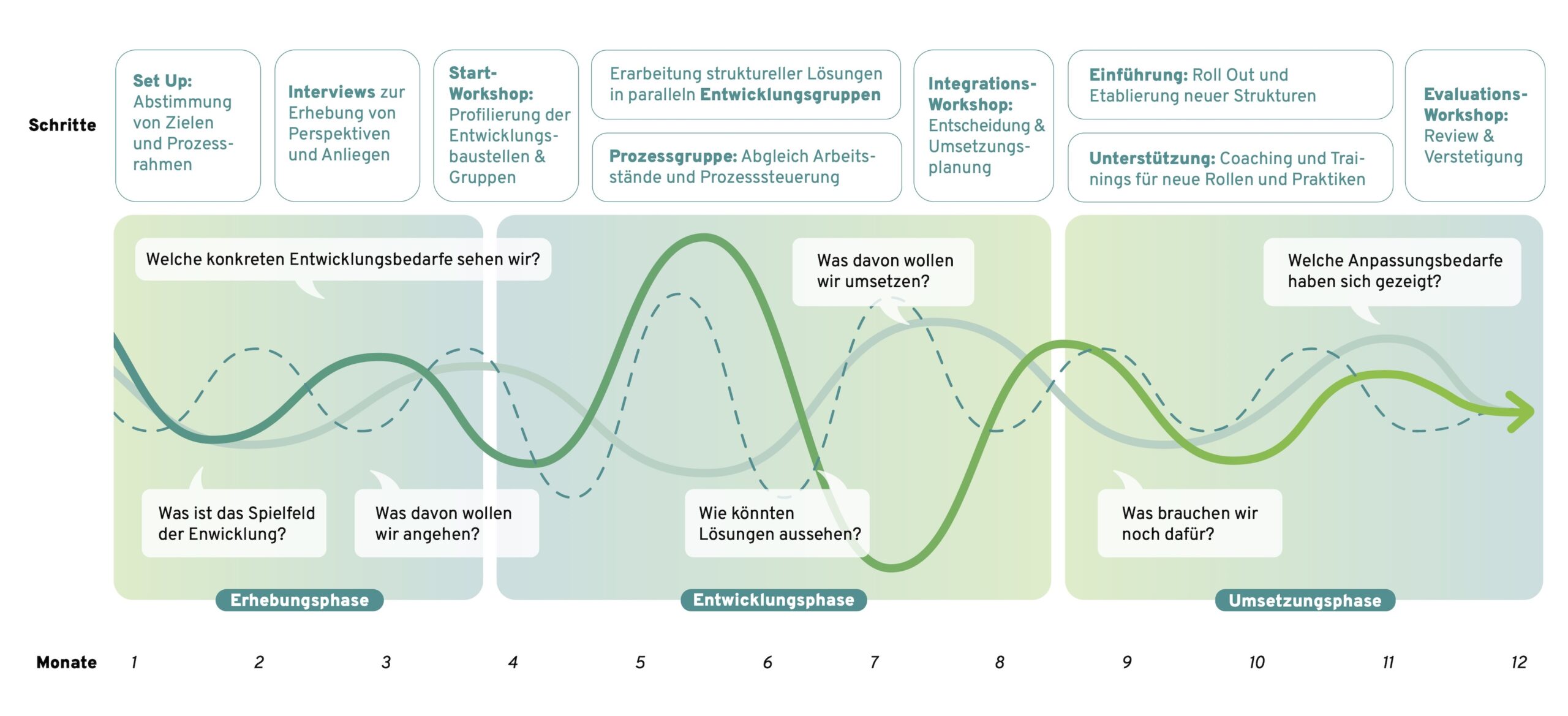
 

We use this process model when a change project is complex, but can be easily planned due to a relatively stable environment. It results in a comparatively high overall workload in the organisation (many people are involved in work processes at the same time). If individual interviews are too time-consuming, we also conduct focus interviews with sub-teams or integrate the assessment into the start workshop. The milestone between development and implementation is a formal decision-making moment (e.g. checkpoint by management committees) that should be formatted very clearly.

Example

U-process

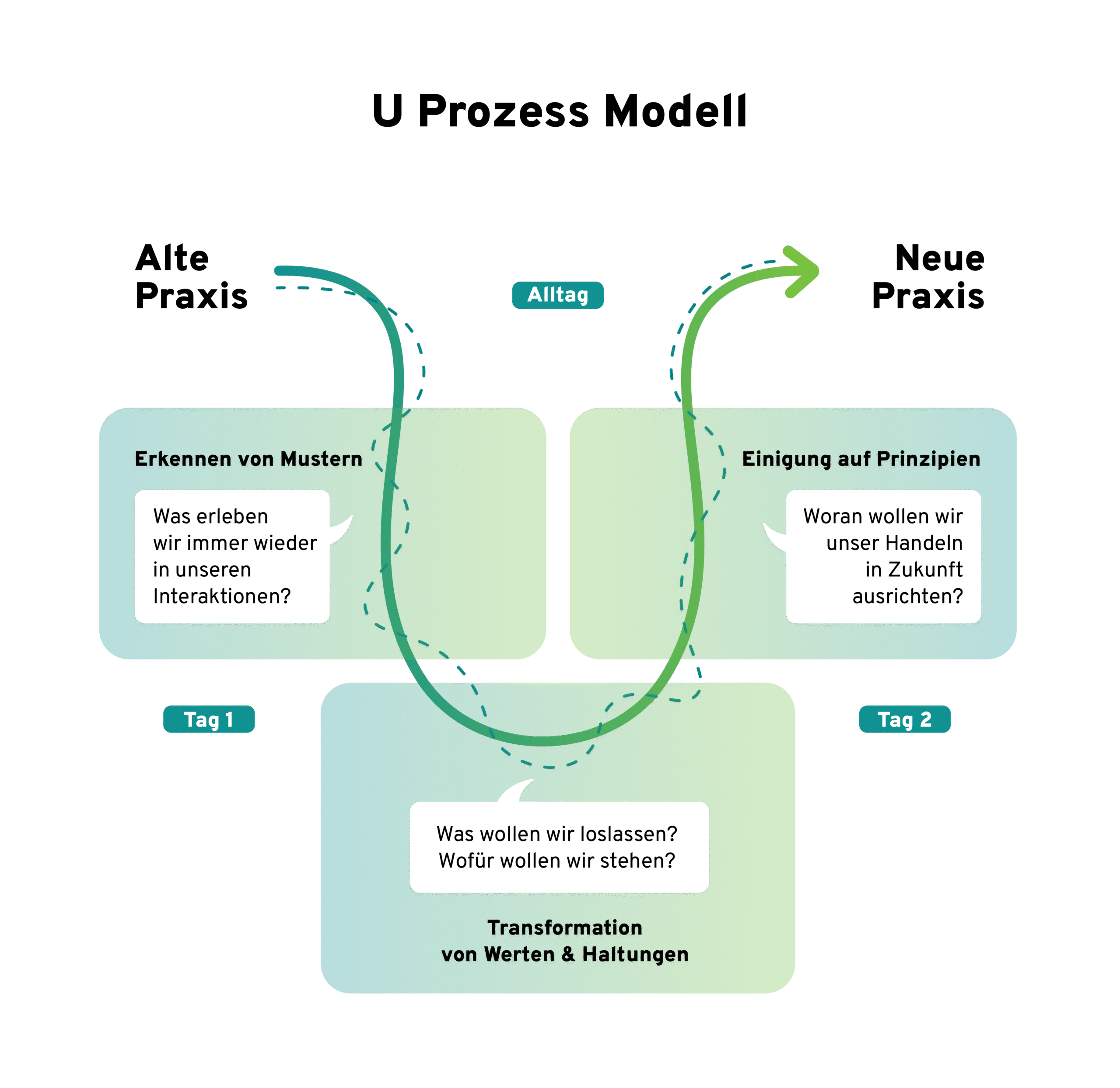
Deep transformation requires deep spaces in which we can reflect on our practice and change the underlying values and attitudes. The U-process described by Otto Scharmer offers a helpful framework for this: We accompany the review of existing work realities and the recognition of formative interaction patterns in the „immersion“, create inspiring spaces „in depth“ in which the collective and personal foundations of these patterns can be transformed and moderate the formulation of jointly supported principles of a new practice in the „emergence“.

  • 2-day workshop
  • Work in the overall team
  • Small groups and individuals
  • Preparation and follow-up by a process group.
Example

Agiles Prozessmodell

  • 2-3 overall team workshops
  • Work in parallel development teams
  • Coordination via process group
  • Duration: 7-9 months Survey and
    Development, 4-6 months accompanied
    Realisation.
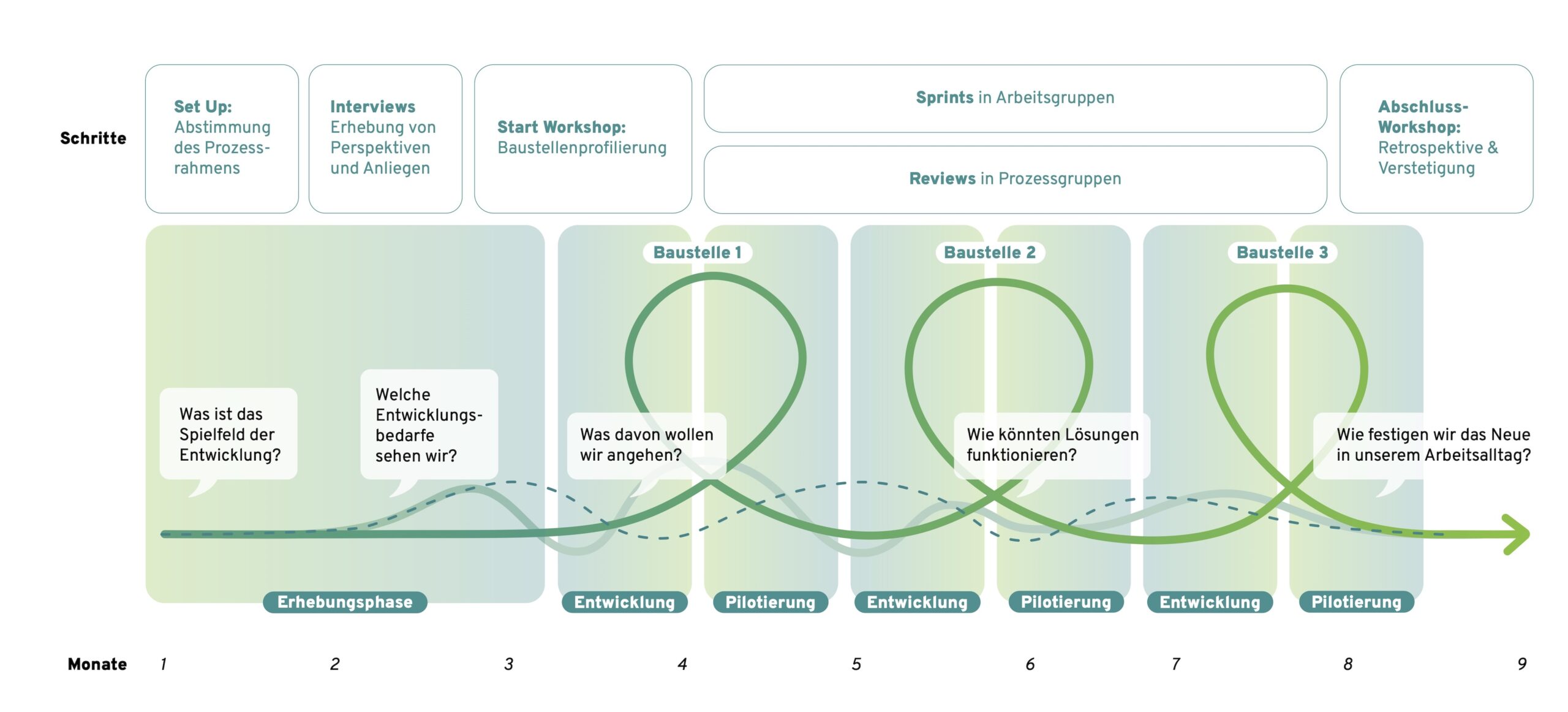
 

We use this process model if the development project takes place in a very dynamic environment or if only limited human resources can be freed up for the process at the same time. The sequential processing of construction sites in sprints requires development initiatives to be self-contained and realisable as a project. The rolling planning of sprints enables an adaptive process with an open goal. 

Final thought:

Regardless of whether you meet for one day for a retreat or schedule a year for a series of workshops - development lives in the process, not in the event. The preparation and follow-up of a meeting, the tension between two sessions, the good conversation while tidying up, the sharpened attention and the constant testing of new practices in everyday working life are the essentials - not the post its that hang on the wall at the end of a retreat.