


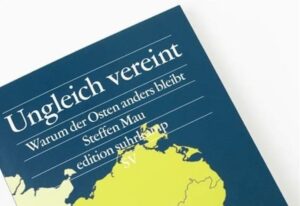
In preparation for the oe-tag 2025 on 13 June 2025 in Halle (Saale), where we want to go on a dialogue-based search for traces of German-German history in organisations, because we believe that “Not everything has been said yet!”, I have been reading. Among other things about “Three East German women who get drunk and found an ideal state” and also Steffen Maus “Unequally united - Why the East remains different”.
Probably one of the most frequently quoted sentences from Maus“ book is “Anyone who uses concepts of guilt in the East-West debate is already on the wrong track.“ And this is precisely why the dialogue at oe-tag 2025 is so important to us, because we are convinced that guilt is not only a misnomer in the ”East-West debate", but actually always.
 In our increasingly diverse and complex society, we as process facilitators in organisational development are constantly faced with one central question: How can collaboration succeed - in society, but also in organisations in concrete terms?
Steffen Mau provides impressive approaches to this: He shows how deeply social differentiation affects our living environments - and how these differences have a direct impact on the way we live together. Particularly relevant here is the deep-rooted East-West divide in Germany, which is underestimated not only in society as a whole, but also in the world of work.
More than top and bottom: Social differentiation rethought
Mau goes beyond classic narratives of inequality. He is not only interested in the contrast between rich and poor or power and powerlessness - but also in the many, often subtle fault lines that run through our society: Education, place of residence, lifestyle, mobility opportunities, but also historical influences such as GDR socialisation in East Germany.
These lines of difference do not create smooth, simple divisions, but complex social maps. In organisations, this means that different horizons of experience, values and expectations clash - only sometimes visibly, but always latently.
East meets West: An underestimated line of conflict in organisations
Mau deals particularly impressively with the lasting influence of the GDR experience - and its after-effects to this day. More than three decades after “reunification”, cultural and social differences persist that are highly relevant in organisations.
Western socialisation and imprinting was elevated to the norm in 1990 and thus led to many East German socialised people suddenly being “different”, according to Mau: they grew up in a system that conveyed “different” norms, a “different” work culture, a “different” relationship to authority and hierarchy. After 1990, these imprints were devalued or made invisible - both in social discourse and in company structures.
In organisations, this still leads to misunderstandings, unspoken tensions or subliminal status conflicts. East German employees often report feeling „overlooked“, „not taken seriously“ or „culturally alien“ - even if they appear to be “fully integrated” or were born after 1990. The social equality that was propagated in the GDR system still clashes here today with Western-style ideals of achievement, pressure to market oneself and hierarchical systems of recognition.
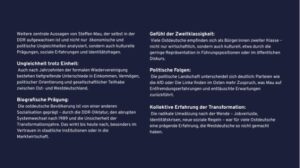
In this context, Steffen Mau speaks of an „asymmetry of visibility“: East German experiences are underrepresented in leadership positions and mission statements in German organisations. This form of structural disregard has a direct impact on cooperation in teams - because how well people cooperate with each other also depends on whether different perspectives are given a place at all.
Cooperation under conditions of social difference
What does this mean for teamwork? Firstly, diversity has another dimension: differences within Germany - such as socialisation in the East and West - are significant. Anyone who wants to lead or work in a team must be aware of these differences. You need to be sensitive to different communication styles, understandings of authority, role models and biographical experiences.
Secondly, organisations still need to learn to see difference not as a disruption, but as a resource. Mau also argues here that social cohesion is not created by uniformity, but by recognising and shaping differences. East-West experiences in particular hold enormous potential - for example in the form of resilience, improvisation talent or team orientation on the one hand, and innovation and competition orientation on the other.
Thirdly, active recognition is needed. Many East German employees have the feeling that their life's work is less appreciated. In teams and organisations, this can lead to withdrawal, silent protest or even mistrust. An open culture of dialogue in which biographical influences can be discussed is therefore essential for functioning cooperation.
Status, recognition and the underestimated power of symbolic differences
Mau also emphasises that modern organisations are not just about material justice - but about recognition. Who is seen? Whose perspective counts? Who defines the „normal“ way of working, communicating and leading?
East Germans in particular often experience a double invisibility: on the one hand because of their regional origin, and on the other hand because they are confronted with codes, networks and self-images in western-style organisations that are different from those in which they grew up or in which they have to constantly adapt. This often leads to silent conflicts of loyalty or distancing mechanisms - even within teams.
The future: polarisation, diversity and a new culture of recognition
Maus' book points to deeper social trends that will challenge organisations even more in the future. In addition to the digital transformation and global migration, it is above all the persistence of inner-German lines of difference that must be taken seriously for us in Germany. Only organisations that ask themselves, who is missing, who is silent and whose perspective is structurally underrepresented, will develop an inclusive and sustainable work culture.
What is needed is a genuine understanding of the deep social structure of cooperation - and the willingness not only to name uncomfortable historical differences, but also to transform them into positive developments.
Conclusion: Unity in diversity needs recognition
Unequally united - why the East remains different is an important book for all those who, even 35 years after “reunification”, find that the inner-German East-West issue is not an anachronism, but a real force in the social architecture of many organisations. Steffen Mau shows that difference is not an obstacle, but a room for manoeuvre.
If you want to shape the collaboration of the future, you have to think beyond traditional categories of diversity. It is about biographical justice, symbolic recognition and the willingness to allow new forms of unity - a unity that is not based on equality, but on respectful difference.
- Suhrkamp Publishing House
- Publication date : 17 June 2024
- Number of pages in the print edition : 168 pages
- ISBN: 978-3518029893
- 18,00 €uro

 Deutsch
  English (UK)