

We don't have a map of the terrain ahead of us - but we can equip our boat to make the most of the wind and currents.
Strategic roadmapping - I apologise for the drama - has had its day. Even its relative looking into the future, backcasting, seems increasingly dusty in view of today's complexity and dynamics. Both methods rely on linear causalities and controllable environments - conditions that hardly exist in the real world. Our reality is an impassable terrain over which fog usually lies. In such situations, flexible routes, detours and learning-orientated navigation are not weaknesses - they are strategic necessities.
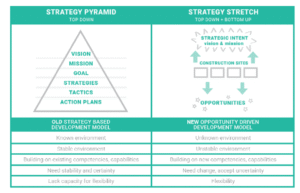
Opportunity Driven Strategy (ODS) - Opportunity-orientated development - offers an agile and ambitious response to this reality. Strategy here is not planned around milestones, but - guided by a clearly formulated Strategic intent - around concrete, developing opportunities. This focus on opportunities is supported by the continuous strengthening of the organisation's ability to access and act. ODS thus dissolves the classic dichotomy of market orientation vs. resource orientation and combines openness to the outside world with an internal focus: attentive to new opportunities and at the same time targeted in the development of organisational capabilities in order to exploit these opportunities. The result: a learning-orientated strategic approach that combines vision and pragmatism.
Building blocke of opportunity-orientated development
Four closely interlinked elements are at the centre of the ODS approach:
Strategic intention
The Strategic intention is the organisation's compass - an ambitious vision of the change it wants to contribute to in the next (+/-) 5 years. It is closer to the ground than a classic vision statement and provides orientation through three dimensions (according to Hamel & Prahalad 2005):
- Direction: a long-term, clear direction;
- Discovery: an open, exploratory attitude;
- Destiny: an emotional response that inspires commitment.
Strategic intent can be defined as Impact narrative are formulated, concretised by 3-5 Impact targets, that specifically define the desired social impact.
Opportunities
Opportunities arise everywhere - both inside and outside the organisation. They range from new funding lines, political changes or market trends to internal reorganisations, innovative ideas or new alliances.
Opportunities cannot be planned for the long term, but must be recognised and exploited in the moment - always through the lens of strategic intent (not every cherry has to be picked from the tree!). Typical areas of opportunity are
- Market opportunitiesNew or insufficiently addressed needs
- Technological opportunitiesInnovations and disruptions
- Regulatory opportunities: Legislative changes and policies
- Operational opportunitiesEfficiency, processes, innovations
- Strategic partnershipsCo-operations, alliances
In the strategy development process, relevant Opportunity clusters identified. In the ongoing strategy cycles, specific opportunities are then monitored and developed.
Development goals
The strategic intention is deliberately formulated so ambitiously that it slightly overstretches the organisation's current capabilities (a planned Strategic Stretch, in contrast to the classic Strategic Fit, which looks at the optimal interplay of existing competences with existing market opportunities). This deliberately created gap between aspiration and reality gives rise to Development goals They relate to the internal competences, structures and processes that need to be built up or transformed in order to make better use of opportunities - such as fast decision-making routines and fluid resource models or the development of new areas of expertise and relationships. The development goals form a structured Backlog for organisational development over the entire strategy period. In each strategy cycle, (+/-) 3 development goals are addressed.
Strategic cycles
ODS replaces fixed roadmaps with agile, rolling strategy cycles. The organisation reflects every 6-9 months:
- What new opportunities are emerging?
- Which steps fit the strategic intention?
- What skills do we need to develop now?
This creates a continuous learning process with long-term directional loyalty and short-term adaptability.
Organisational ambidexterity
While opportunity-orientation characterises the ODS approach, routine tasks and stable backbone functions are of course not abolished. In addition, many programmes are fixed by long-term performance and funding contracts and cannot simply be thrown overboard in an opportunity-oriented manner. Organisations therefore need the dual competence known as ambidexterity to Exploration and Exploitation (i.e. the innovative development of the new and the efficient management of the existing). Structurally, there are two basic architectures for this:
- Two-track architecture: One part of the team ensures stability in regular operations (with classic strategic planning), while another is entrusted with innovation and the development of opportunities in changing fields (in the ODS model). Resources are shifted between the areas as required.
- Integrated architecture: All areas of work are opportunity-orientated. Tasks with a more routine character are being further developed, particularly in the way they are implemented (How). Tasks with a flexible commitment are also reorganised in terms of content along the strategy cycles (What).
What ODS is - and what it is not
ODS is not a free pass for Ad hocism and haphazard reactions and no rejection of long-term orientations. ODS is a structured framework for taking targeted action with a strategic compass in a complex, dynamic environment.
- Exploration and goal-orientation are not mutually exclusive: Strategic intent creates focus.
- Adaptability is not small thinking: ODS also enables major leaps in development.
- Seizing opportunities is not a diversion - it is the way: Strategy unfolds through concrete action in the moment.
Many organisations have long been working in an opportunity-oriented way - often with mixed feelings about the outdated roadmaps in the drawer and without the stringency of continuous development. ODS gives this strategic practice a language and structure.
However, the approach does not provide a turnkey package. It requires adaptation and interpretation of the central building blocks. Last but not least, it also requires a degree of cultural development: this includes a willingness to take risks and make mistakes, the ability to recognise new things and the willingness to abandon established practices.
I believe very strongly in the Opportunity Driven Strategy, am working on its implementation in various areas and am always happy to have good conversations about it!
Further reading
- Hamel & Prahalad (1994): Competing for the Future
- Hamel & Prahalad (2005): Strategic Intent - Harvard Business Review
- Peter Skat-Rørdam (1999): Changing Strategic Direction
- Witek-Crabb (2022): Stretch and Strategic Misfit
- Strategy Works: Strategic Opportunity Management
This and other texts in English: Lost Navigator

 Deutsch
  English (UK)